
New Delhi is in full preparation mode as India gets ready to host the 18th BRICS Summit on September 12 and 13, 2026 at Bharat Mandapam.
There is plenty happening around the summit — global leaders arriving in Delhi, tight security, diplomatic meetings and discussions on trade, technology and international cooperation.
But one detail has caught people’s attention for a very different reason.
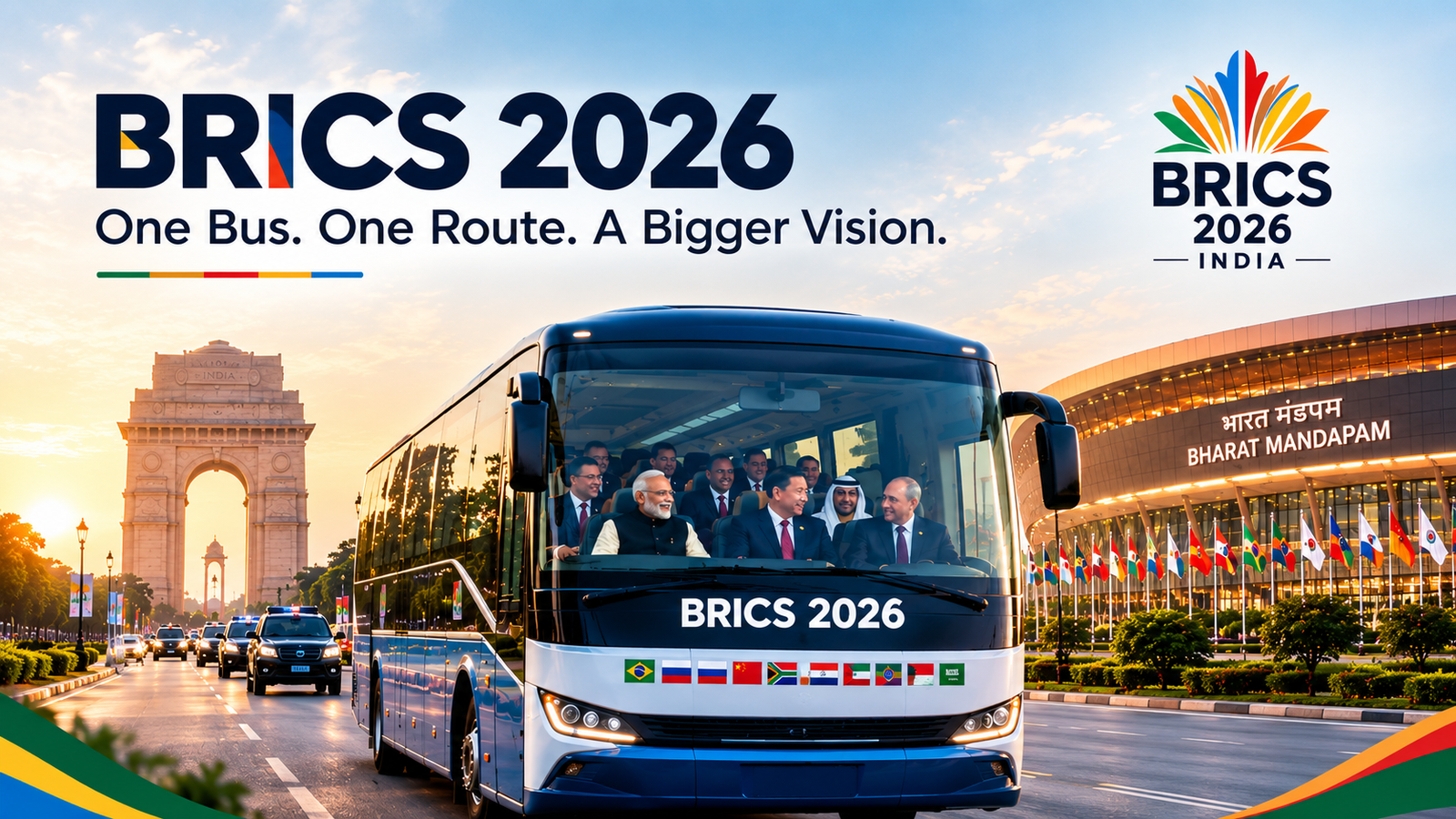
Instead of moving separately in multiple VIP convoys, Indian ministers and chief ministers attending the summit are expected to travel together from Parliament to Bharat Mandapam.
It may sound like a small logistical decision.
It isn’t.
Why is the one-bus plan important?
Anyone who has spent time in Delhi knows what a major VIP convoy can do to traffic.
A single high-profile movement can mean road restrictions, security checks and diversions across already busy routes. Multiply that by several ministers and senior leaders, and the disruption can quickly become much larger.
Travelling together helps reduce the number of separate convoys on the road.
It also makes coordination easier for security agencies while potentially reducing the impact on everyday traffic.
For a city hosting one of the year’s biggest international diplomatic events, that matters.
And there is another side to it.
Seeing senior political leaders travel together rather than arriving in a long line of separate vehicles creates a much simpler image of leadership.
India is hosting BRICS at an important moment
The BRICS Summit 2026 is taking place at a time when the global economy and international politics are changing quickly.
BRICS has also changed considerably since the group was first established.
The expanded grouping now includes 11 member countries, bringing together major emerging economies across Asia, Africa, the Middle East and South America. The bloc represents close to half of the world’s population.
India assumed the BRICS chairship on January 1, 2026, for the fourth time.
This year’s theme is “Building for Resilience, Innovation, Cooperation and Sustainability,” with a broader people-focused approach built around the idea of “Humanity First.”
That theme is not limited to the two-day leaders’ summit.
India has spent much of 2026 hosting BRICS meetings across different sectors, including trade, energy, finance, technology and other areas of cooperation. More than 350 meetings and high-level engagements have been held across more than 25 Indian cities during the chairship.
What could BRICS leaders discuss?
The summit comes with a fairly broad agenda.
One major area is global governance.
India has been pushing for greater representation for developing and emerging economies in international institutions. The leaders’ discussions are expected to look at ways to strengthen multilateral cooperation.
Technology and digital payments are another important area.
India is reportedly pushing discussions around connecting central bank digital currencies among BRICS countries to make cross-border payments easier. There are still significant technical and political challenges, but the proposal shows where economic cooperation within the bloc could be heading.
Trade is also high on the agenda.
Earlier this year, BRICS trade ministers worked on proposals related to the BRICS Economic Partnership 2030, MSME financing and more resilient global supply chains.
BRICS 2026 is bigger than a two-day event
It is easy to look at the summit as simply another meeting where presidents and prime ministers sit around a table.
But India’s BRICS chairship has been running throughout 2026.
The focus has included three broad areas:
- Political and security cooperation
- Economic and financial cooperation
- Cultural and people-to-people exchanges
There has also been a strong emphasis on entrepreneurship, youth, sustainability and innovation.
That makes the Delhi summit more like the final stage of a year-long diplomatic programme rather than a standalone event.
And then there is Delhi
For residents, BRICS 2026 is not just about international politics.
It is also affecting everyday life.
Security arrangements have been increased across the capital, and authorities have taken measures to manage movement around the summit. Schools in Delhi were also ordered to remain closed on September 11 because of the event and the expected logistical impact.
This is where the decision to reduce separate VIP movements becomes particularly relevant.
International diplomacy may be happening inside Bharat Mandapam, but outside the venue, millions of people still need to get to work, school, shops and home.
Keeping those two realities in balance is part of hosting a summit of this scale.
The bigger picture
The “one bus” story might never become the most important headline from BRICS 2026.
The bigger questions will be about trade, technology, global governance, payments, investment and how effectively such a diverse group of countries can actually work together.
Still, the image is interesting.
Different leaders.
Different political priorities.
Different countries.
But for one journey, a shared route.
And perhaps that is a fitting image for what BRICS itself is trying to achieve — different interests finding enough common ground to move in the same direction.
Final Takeaway
The BRICS Summit 2026 in New Delhi is about much more than the leaders arriving at Bharat Mandapam.
India is using its BRICS chairship to push discussions around cooperation, innovation, economic development and a greater role for emerging economies in global decision-making.
And while the one-bus arrangement is mainly a practical solution to security and traffic management, it has also become a small symbol of the summit itself.
Sometimes, the most noticeable changes aren’t the ones happening on the main stage.