

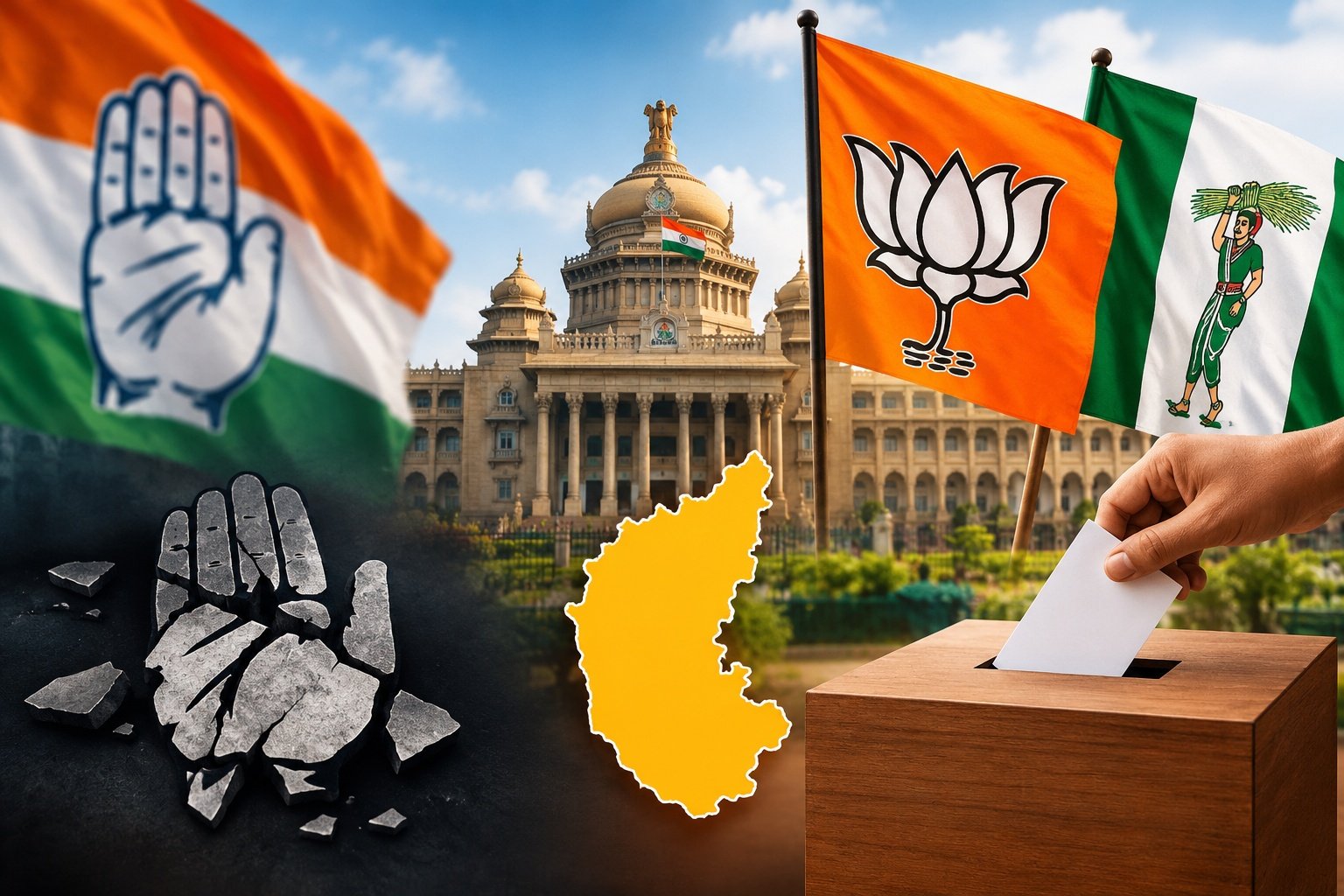
The Indian National Congress suffered a setback in Karnataka after failing to win any of the four Legislative Council seats contested in the October 2026 elections. The Bharatiya Janata Party (BJP) won three seats, while its National Democratic Alliance (NDA) partner, Janata Dal (Secular), secured the fourth. The results were announced on October 27 and 28. Source: The News Minute.
The outcome has drawn attention because Congress is the ruling party in Karnataka. It also gives the BJP-JD(S) alliance an opportunity to challenge the state government politically ahead of future electoral contests.
Karnataka MLC Election Results 2026: Key Highlights
The elections covered four constituencies representing teachers and graduates. Voting took place on October 23, with the results showing a complete sweep for the BJP-JD(S) alliance.
Key results included:
- Bengaluru Teachers’ Constituency: JD(S) candidate A. P. Ranganath defeated sitting Congress MLC Puttanna by 908 votes.
- North-East Teachers’ Constituency: BJP candidate Shashil G. Namoshi defeated Congress candidate Sharanappa Mattur.
- South-East Graduates’ Constituency: BJP candidate K. M. Suresha defeated Congress nominee Shashi Hulikunte Mutt.
- West Graduates’ Constituency: BJP candidate S. V. Sankanur defeated Congress candidate Mohan Limbikai.
The results meant Congress finished without a victory in the four constituencies, while the BJP retained three seats and JD(S) won the Bengaluru Teachers’ seat previously held by Congress. Source: News9Live.
Why Did Congress Lose the Karnataka MLC Elections?
The election results have prompted questions about Congress’s performance among teachers and graduates. However, the results alone do not establish one definitive reason for the party’s losses.
Several factors are relevant to understanding the outcome.
1. BJP-JD(S) Coordination
The BJP and JD(S) contested the four seats as alliance partners. The BJP won three constituencies, while JD(S) captured the Bengaluru Teachers’ seat.
The outcome demonstrated the alliance’s ability to coordinate its candidates across these contests. Analysts have highlighted cooperation between the two parties as an important factor in the result. Source: The News Minute.
2. Loss of a Sitting Congress Seat
One of the most notable results came from Bengaluru Teachers’ Constituency, where JD(S) candidate A. P. Ranganath defeated Congress’s Puttanna by 908 votes.
The defeat was significant because Puttanna was an established Legislative Council member seeking re-election. The result also showed that Congress could not retain its position in this constituency despite being in power at the state level. Source: News9Live.
3. Questions About Support Among Teachers and Graduates
These elections are different from general Assembly elections because voting is restricted to eligible voters in specific teachers’ and graduates’ constituencies.
The results therefore provide information about the outcome of these particular contests, not a complete picture of public opinion across Karnataka. A broader assessment of Congress’s support would require evidence from other elections, voter surveys, and constituency-level analysis.
Does the Result Threaten the Congress Government in Karnataka?
The loss is a political setback, but it does not automatically threaten the stability of the Congress government.
Legislative Council elections and Assembly elections have different electorates and purposes. The four MLC results do not, by themselves, change the party’s position in the Legislative Assembly or determine who governs the state.
Congress leaders have also cautioned against interpreting the outcome as a direct prediction of future elections. Karnataka Chief Minister D. K. Shivakumar said the party would examine its performance and rejected the suggestion that the results necessarily forecast the outcome of future contests. Source: India Today.
What Does the Result Mean for BJP and JD(S)?
The result gives the BJP and JD(S) a fresh political talking point against the ruling Congress government.
For the BJP, retaining three seats reinforces its position in the constituencies it contested. For JD(S), winning the Bengaluru Teachers’ seat represents a gain at Congress’s expense.
The alliance’s performance will likely feature in political discussions about opposition coordination in Karnataka. However, its impact on future elections will depend on several factors, including candidate selection, local issues, party organisation, voter priorities, and how effectively the alliance maintains cooperation.
What Happens Next for Congress?
Congress will need to examine the results constituency by constituency rather than assume that one factor explains every defeat.
Possible areas for review include candidate selection, engagement with teachers and graduates, local campaign organisation, and communication about issues affecting the voters in these constituencies. These are areas for investigation, not confirmed explanations for the losses.
The party’s response may also be assessed through its performance in subsequent elections and its ability to address concerns raised by its local supporters.
For the BJP-JD(S) alliance, the challenge will be to build on the results while maintaining coordination beyond these four contests.
Conclusion
Congress’s defeat in all four Karnataka Legislative Council constituencies marks a setback for the ruling party. The BJP won three seats, and JD(S) secured the Bengaluru Teachers’ constituency, ending Congress’s campaign without a win in the four-seat contest.
The result highlights the importance of alliance coordination and constituency-level campaigning. At the same time, it should be understood in context: MLC elections involve a specific electorate and do not, on their own, determine the future of Karnataka’s state government.
The next stage will be to see how Congress responds to the result and whether the BJP-JD(S) alliance can maintain its coordination in future political contests.
Frequently Asked Questions
1. Did Congress lose the Karnataka MLC elections in October 2026?
Yes. Congress failed to win any of the four Karnataka Legislative Council seats contested in the October 2026 elections.
2. How many seats did the BJP win?
The BJP won three of the four seats. Its NDA partner, JD(S), won the remaining seat.
3. Which seat did JD(S) win?
JD(S) candidate A. P. Ranganath won the Bengaluru Teachers’ Constituency, defeating Congress MLC Puttanna by 908 votes.
4. Does the result mean Congress has lost power in Karnataka?
No. The MLC results do not automatically change the Congress government’s position in the Karnataka Legislative Assembly.