
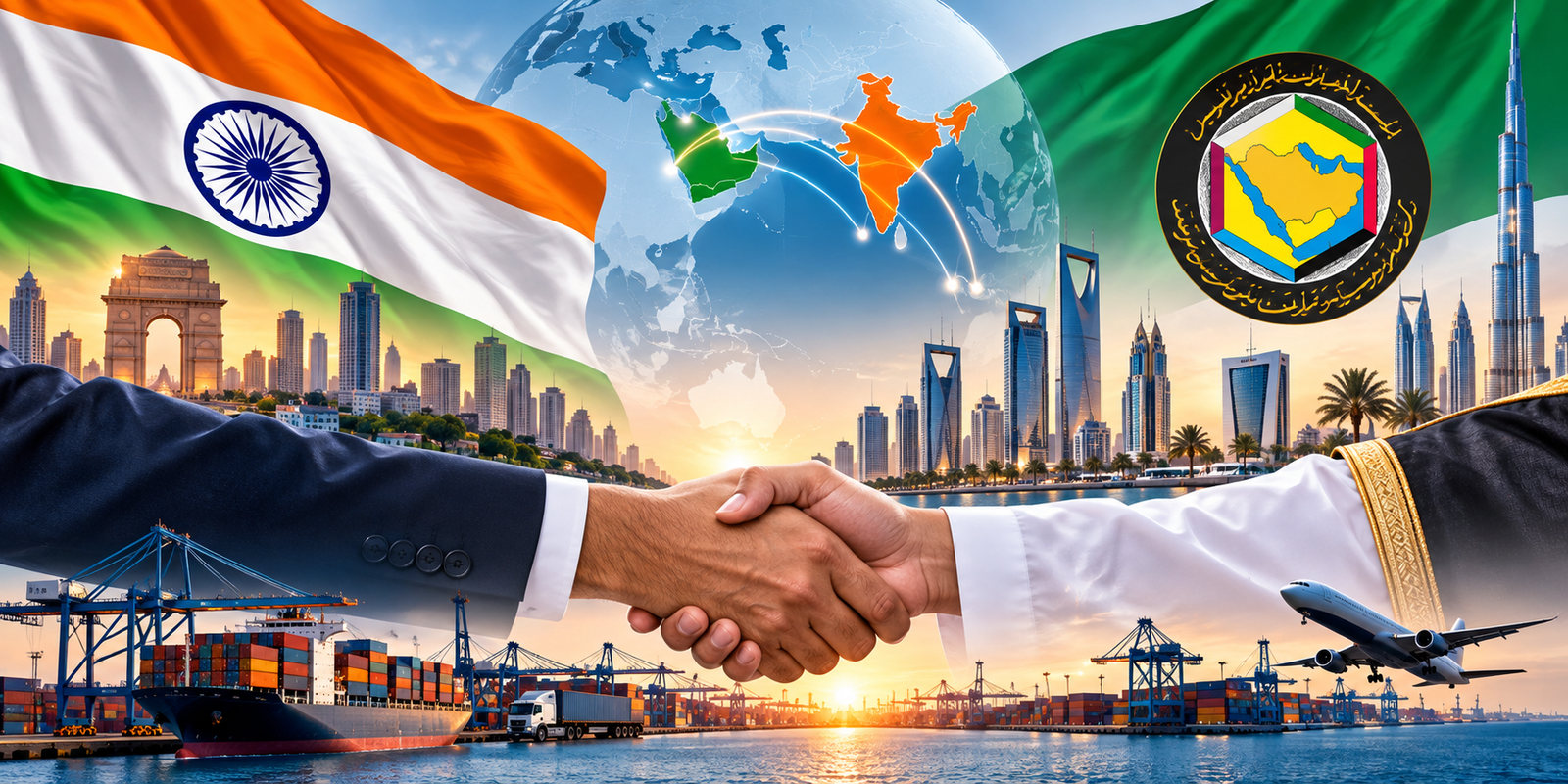
India and the Gulf Cooperation Council (GCC) are moving ahead with discussions on a proposed India-GCC Free Trade Agreement, opening a new phase in the economic relationship between India and the Gulf region.
The development comes as India continues to strengthen its commercial relationships with Gulf countries, which are important markets for Indian goods, services, investment and skilled professionals.
The GCC consists of Saudi Arabia, the United Arab Emirates, Qatar, Kuwait, Bahrain and Oman. Together, these countries represent an important economic region for India because of their proximity, trade links, energy relationships and large Indian business and professional presence.
India and GCC Begin Free Trade Agreement Discussions
India and the GCC have agreed to move forward with negotiations for a proposed free trade agreement.
The discussions were reviewed during a GCC-India Troika Ministerial Meeting held in New York, where both sides also discussed cooperation under their existing Joint Action Plan.
The proposed agreement is intended to provide a framework for expanding trade and economic cooperation between India and the six GCC member states.
While negotiations are still ongoing, the eventual agreement could address areas such as trade in goods, services, market access and other economic issues.
Why the GCC Is Important for India
The Gulf region has long been an important economic partner for India.
India’s relationship with the GCC extends across several areas, including:
- Energy and oil imports
- Merchandise trade
- Information technology services
- Construction and infrastructure
- Financial services
- Food and agricultural products
- Pharmaceuticals
- Engineering goods
- Tourism and aviation
- Remittances
The large Indian-origin community across Gulf countries has also contributed to long-standing commercial and cultural connections between the two regions.
A formal trade agreement could provide another framework for developing these relationships.
India-UAE Trade Shows the Potential of Gulf Markets
The United Arab Emirates is already one of India’s important trading partners in the Gulf.
India and the UAE have an existing Comprehensive Economic Partnership Agreement (CEPA), which entered into force in 2022.
The agreement significantly reduced tariffs on a large number of products and was designed to increase bilateral trade and investment.
The experience of India-UAE economic cooperation provides a relevant example of how trade agreements can influence commercial relationships.
However, the proposed India-GCC agreement would involve six countries, meaning negotiations could be more complex.
Which Indian Industries Could Be Affected?
The impact of a future India-GCC trade agreement would depend heavily on the final terms negotiated by both sides.
Several Indian industries could potentially benefit from improved market access.
Engineering and Manufacturing
India’s engineering and manufacturing companies already export products to Gulf markets.
These include machinery, electrical equipment, industrial products, construction materials and engineering goods.
Lower trade barriers could potentially improve market access for some Indian manufacturers, depending on the products covered by the final agreement.
Pharmaceuticals
India is a major global supplier of generic medicines and pharmaceutical products.
Gulf markets represent an important destination for healthcare-related products, although pharmaceutical trade is also influenced by regulatory requirements, approvals and local market rules.
A trade agreement could potentially address some barriers, but regulatory standards would continue to matter.
Food and Agricultural Products
The Gulf region imports a significant amount of food because of its climate and limited agricultural land.
Indian exporters supply products including rice, spices, fruits, vegetables and processed food.
Improved trade arrangements could create opportunities for exporters if tariff and non-tariff barriers are reduced.
Information Technology and Professional Services
India’s services sector could also be relevant to the negotiations.
Indian companies provide IT, consulting, engineering, financial and professional services to businesses across the Gulf.
Trade agreements increasingly cover services alongside physical goods, although the specific commitments will depend on negotiations.
What Could the Trade Deal Mean for Indian Exporters?
For Indian exporters, easier access to Gulf markets could potentially reduce certain costs and improve competitiveness.
However, businesses should not assume that a free trade agreement automatically removes every barrier.
Exporters would still need to consider:
- Product standards
- Certification requirements
- Customs procedures
- Rules of origin
- Local regulations
- Packaging requirements
- Taxes and fees
- Competition from other international suppliers
The final details of the agreement will therefore be important for determining which businesses see the greatest practical impact.
Gulf Countries Are Also Important for Indian Investment
The relationship is not limited to exports.
Gulf sovereign wealth funds, companies and investors have increasingly shown interest in Indian sectors such as infrastructure, technology, renewable energy, logistics, real estate and financial services.
At the same time, Indian companies have expanded their operations across Gulf markets.
A broader economic agreement could potentially support investment flows in both directions.
Energy Remains a Major Part of the Relationship
Energy continues to be one of the most important areas of India-Gulf economic relations.
India is a major energy importer, while several GCC countries are major producers and exporters of oil and gas.
This makes the Gulf strategically important to India’s energy security and economic planning.
At the same time, both India and Gulf countries are investing in renewable energy, green technologies and other emerging areas.
Future economic cooperation could therefore extend beyond traditional oil and gas trade.
How Will the India-GCC Trade Deal Negotiations Progress?
The proposed agreement is still under negotiation, meaning the final outcome cannot yet be determined.
Trade negotiations generally involve discussions over tariffs, market access, services, investment, rules of origin and other areas.
India and GCC countries will need to reach agreement on these issues before a final deal can be implemented.
Businesses should therefore distinguish between the launch of negotiations and an actual completed trade agreement.
The current development indicates that both sides are willing to explore a deeper economic relationship, but the commercial impact will become clearer only as negotiations progress.
What Businesses Should Watch Next
Indian companies doing business with the Gulf will be watching several developments closely.
These include:
- Products included in tariff negotiations
- Rules of origin
- Services-sector commitments
- Investment provisions
- Customs and trade facilitation measures
- Standards and regulatory requirements
- Implementation timelines
These details will determine how useful the eventual agreement is for individual industries.
India-GCC Trade Relationship Enters a New Phase
The decision to begin India-GCC Free Trade Agreement negotiations represents another step in the development of economic relations between India and the Gulf.
The GCC is already an important commercial partner for India, while Indian companies have significant business interests across the region.
For exporters and service providers, a successful agreement could potentially create new opportunities. For importers and manufacturers, changes in tariffs and market access could also influence sourcing and competition.
However, the negotiations are still underway, and businesses will need to wait for the final terms before assessing the agreement’s precise impact.
Frequently Asked Questions
What is the India-GCC Free Trade Agreement?
The India-GCC Free Trade Agreement is a proposed trade agreement between India and the six GCC member countries: Saudi Arabia, UAE, Qatar, Kuwait, Bahrain and Oman.
Have India and GCC countries signed the trade agreement?
No. India and the GCC have launched negotiations for the proposed agreement. The final terms have not yet been concluded.
Which countries are members of the GCC?
The GCC consists of Saudi Arabia, the United Arab Emirates, Qatar, Kuwait, Bahrain and Oman.
Which Indian industries could benefit from stronger Gulf trade?
Potentially affected sectors include engineering, manufacturing, pharmaceuticals, food products, textiles, technology and professional services. The actual impact will depend on the final agreement.
Why is the Gulf region important for India?
The Gulf is important to India because of its energy supplies, trade relationships, investment links, services markets and large Indian-origin community.
Conclusion
India’s proposed Free Trade Agreement with the GCC could become an important development for the country’s trade and investment relationship with the Gulf.
The negotiations are still at an early stage, and the final economic impact will depend on the terms agreed by both sides.
For Indian businesses, particularly exporters and service providers, the negotiations will be worth monitoring as details emerge on tariffs, market access, investment and services.
Know More : https://24x7world.com/ashish-vaidya-ml-books-international-daryaganj/